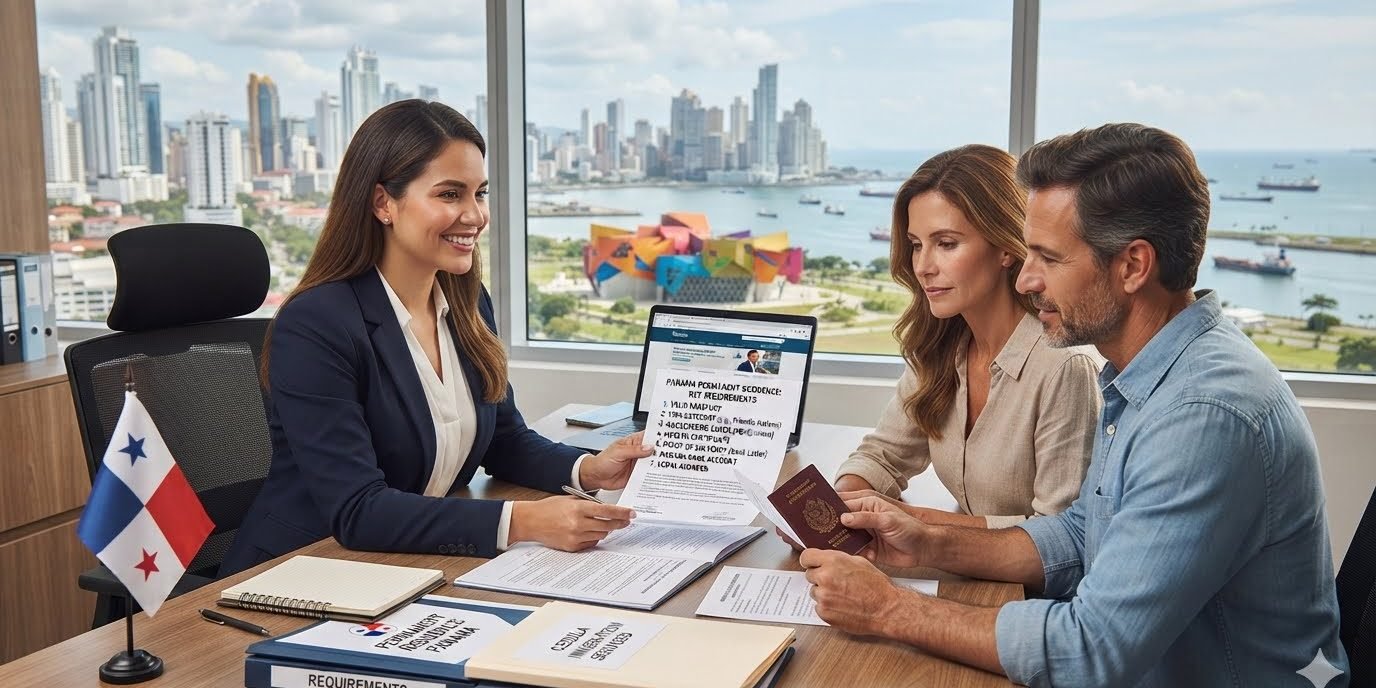
Requirements for Obtaining Permanent Residence in Panama
Panama is an attractive country for foreigners seeking to live and work permanently. The country offers a stable economy, a tropical climate, and a variety of job opportunities.
To obtain permanent residence in Panama, foreigners must meet the requirements established by the National Migration Service of Panama.
Requirements for Obtaining Permanent Residence in Panama
Panama has become an attractive destination for individuals, families, retirees, investors, and international professionals looking to establish long-term residence in a stable and internationally connected country.
With its strategic location between North and South America, a U.S. dollar-based economy, modern banking and business infrastructure, international air connections, and a wide range of residency programs, Panama offers several legal pathways for foreign nationals who wish to establish temporary or permanent residence in the country.
However, obtaining permanent residence in Panama is not based on one single immigration program. The requirements depend on the applicant's nationality, personal circumstances, financial situation, professional activity, family connections, and the specific immigration category under which the application is submitted.
Who Can Apply for Permanent Residence in Panama?
Foreign nationals may qualify for residence in Panama through different immigration programs established under Panamanian law.
Depending on the applicant's profile, residency may be available through investment, retirement income, employment, economic or professional ties, family relationships, special international agreements, or other legally recognized categories.
Some immigration programs may provide a pathway to permanent residence after an initial temporary or provisional period, while certain qualifying investment programs may allow eligible applicants to apply directly for permanent residence.
For this reason, identifying the correct immigration category before beginning the application is one of the most important steps in the process.
General Requirements for Panama Residency
Although every residency program has its own specific requirements, applicants are generally required to provide a combination of personal, legal, financial, and immigration documents.
Depending on the residency category, these may include:
- A valid passport.
- A complete notarized copy of the passport.
- An apostilled or properly legalized criminal background certificate from the applicant's country of origin or residence, when applicable.
- A health certificate issued in Panama.
- Passport-size photographs.
- A sworn declaration containing the applicant's personal background information.
- Evidence demonstrating eligibility for the selected residency category.
- Proof of financial capacity, pension income, employment, investment, bank deposits, real estate ownership, or other qualifying economic ties, when required.
- Marriage and birth certificates for spouses and dependent children, where applicable.
- Official Spanish translations of foreign-language documents when required.
- Powers of attorney, immigration forms, and other legal documentation prepared for filing before the Panamanian authorities.
The exact documentation can vary considerably depending on the immigration program and the applicant's individual circumstances.
Apostille and Legalization of Foreign Documents
Documents issued outside Panama generally need to be properly authenticated before they can be presented to Panamanian authorities.
For countries participating in the Hague Apostille Convention, qualifying public documents can normally be authenticated through an apostille issued by the competent authority in the country where the document originated.
Documents originating from countries where the apostille procedure is not applicable may require consular legalization or another authentication procedure.
Foreign documents that are not issued in Spanish may also need to be translated into Spanish by an authorized public translator in Panama.
Because criminal records, civil-status certificates, and other supporting documents may have validity periods for immigration purposes, applicants should carefully coordinate document preparation with the expected filing date.
Proof of Economic or Financial Eligibility
Many Panama residency programs require applicants to demonstrate a specific economic connection or source of financial support.
Depending on the immigration category, this may involve proving:
- Pension or retirement income.
- Employment in Panama.
- Ownership of qualifying real estate.
- Investment in Panama.
- A qualifying fixed-term bank deposit.
- Ownership or participation in a Panamanian company where permitted by the applicable immigration category.
- Family or marital relationships.
- Other financial or professional qualifications recognized under Panamanian immigration law.
The required amount and type of evidence are different for each residency program. Applicants should therefore avoid assuming that financial requirements applicable to one visa category also apply to another.
Main Pathways to Residence in Panama
Panama offers several immigration categories for foreign nationals seeking legal residence.
Panama Pensionado Residency
The Pensionado program is designed primarily for applicants who receive a qualifying lifetime pension or retirement income.
It is one of Panama's best-known residency programs and can be particularly attractive to foreign retirees who want to establish their principal or secondary residence in Panama.
Applicants must provide official evidence of the qualifying pension together with the required personal and immigration documentation.
Friendly Nations Residency
Nationals of countries included under Panama's applicable Friendly Nations regulations may have access to a residency pathway when they meet the corresponding legal and economic requirements.
Eligibility is not based on nationality alone. Applicants must also satisfy the requirements of the immigration category under which they apply.
Qualified Investor Residency
The Qualified Investor program is designed for foreign nationals making a qualifying investment in Panama.
Depending on the investment structure and applicable regulations, qualifying investments may include real estate and other legally authorized investment alternatives.
This program is particularly relevant for investors seeking a more direct route toward permanent residence.
Because investment thresholds and regulatory requirements can change, applicants should confirm the requirements applicable at the time they intend to invest and submit their application.
Residency Through Family Relationships
Foreign nationals with qualifying family relationships in Panama may also have immigration options.
The applicable procedure depends on the nature of the relationship, such as marriage to a Panamanian citizen, dependent relationships, or other categories recognized under Panamanian immigration law.
Other Residency Categories
Additional immigration options may be available for certain professionals, investors, workers, entrepreneurs, nationals covered by special treaties, and applicants who meet specific economic or legal criteria.
Choosing the correct category should always be based on the applicant's actual circumstances rather than simply selecting the residency program that appears easiest or fastest.
Applying With a Spouse and Children
Many Panama residency programs allow the principal applicant to include qualifying dependents.
Depending on the immigration category, dependents may include a spouse and eligible children. Additional documentation is normally required to establish the family relationship, including apostilled or legalized marriage and birth certificates.
Financial requirements and government fees may also increase when dependents are included.
Families planning to relocate together should review the complete family structure before filing so that the applications can be coordinated correctly.
The Panama Residency Application Process
The procedure depends on the residency category, but a typical application involves several stages.
The first step is determining the appropriate immigration program and confirming eligibility. The applicant then prepares the required documents in Panama and abroad, including apostilles, legalizations, translations, financial evidence, and civil-status documents where applicable.
Once the documentation is complete, the legal application is prepared and submitted to the competent Panamanian authorities.
Depending on the immigration category, the applicant may receive an immigration processing card or provisional documentation while the application is under review.
After the authorities complete their review and the application is approved, the corresponding residency documentation can be issued.
Processing times vary according to the immigration category, documentation, nationality, government review, and complexity of the individual case.
Does Permanent Residence Mean Panamanian Citizenship?
No.
Permanent residence gives a foreign national the legal right to reside in Panama under the conditions of the applicable immigration status. It does not automatically make the person a Panamanian citizen.
Naturalization is a separate legal procedure with its own eligibility requirements, residence periods, documentation, and government review.
Applicants interested in eventually obtaining Panamanian citizenship should consider their long-term objectives when selecting their initial residency strategy.
Can Permanent Residents Work in Panama?
Immigration residency and authorization to work are separate legal matters.
Obtaining residence does not necessarily mean that the applicant automatically has unrestricted authorization to work in Panama.
Depending on the applicant's immigration status and professional activity, a separate work permit may be required. Certain professions may also be restricted or regulated under Panamanian law.
Applicants intending to work, establish a business, or provide professional services in Panama should review both immigration and labor requirements.
How Long Does It Take to Obtain Residence in Panama?
There is no single processing time applicable to every Panama residency application.
The timeline depends on the immigration category, the completeness of the documentation, the applicant's nationality and circumstances, and the review carried out by the competent authorities.
Some specialized investment programs may offer significantly faster procedures, while other residency categories involve provisional stages before permanent residence can be obtained.
Preparing the application correctly from the beginning can help avoid unnecessary delays caused by incomplete, expired, incorrectly legalized, or inconsistent documentation.
Choosing the Right Panama Residency Program
The best residency option depends on much more than the applicant's nationality.
Before starting the process, it is important to consider factors such as:
- Nationality and current country of residence.
- Age and family composition.
- Employment or business activities.
- Pension or retirement income.
- Available investment capital.
- Real estate plans.
- Banking and source-of-funds requirements.
- Whether the applicant intends to work in Panama.
- Whether the objective is temporary residence, permanent residence, or eventual naturalization.
A residency strategy should be designed around the applicant's complete profile and long-term objectives.
Professional Assistance with Panama Permanent Residence
ImmigrationVisa247 assists foreign individuals, families, retirees, and investors with Panama immigration and residency procedures.
Our team can coordinate the process from the initial eligibility review through document preparation and submission, including assistance with apostilles and legalizations, official translations, health certificates, immigration documentation, banking requirements, corporate structures, qualifying real estate transactions, and related legal services where required.
Before proceeding, we review the applicant's circumstances to determine which residency pathway may be appropriate and which documents should be prepared.
This approach helps applicants understand the process, expected requirements, and estimated costs before making important immigration or investment decisions.
Start Your Panama Residency Process
If you are considering relocating, retiring, investing, working, or establishing a business in Panama, the first step is to determine which residency category best matches your circumstances.
Every case is different, and immigration requirements may change depending on the applicant's nationality, family structure, source of income, investment plans, and intended activities in Panama.
ImmigrationVisa247 can provide an initial review of your situation and explain the available options before you begin the formal residency process.
Panama–Italy Treaty Residency
Italian citizens may have access to a special residency pathway in Panama under the bilateral Treaty of Friendship, Commerce and Navigation between Panama and Italy.
This immigration option is different from the general residency programs available to other nationalities and can provide an attractive route for Italian nationals wishing to establish legal residence in Panama.
Applicants must comply with the documentation, financial, and immigration requirements applicable at the time of filing. Family members may also be eligible under the corresponding rules.
Because this residency category is based on a specific treaty, Italian citizens considering relocation to Panama should have their eligibility reviewed separately rather than assuming that the requirements of the Friendly Nations or other residency programs apply to them.
Residency Options for South African Citizens
South African citizens interested in relocating to Panama may also have several residency options depending on their personal and financial circumstances.
The appropriate route may be based on investment, retirement income, employment, economic solvency, family relationships, or another immigration category for which the applicant qualifies.
South African applicants should pay particular attention to the preparation and authentication of documents issued in South Africa, including criminal background certificates, civil-status documents, and proof of financial resources or source of funds where required.
Applicants planning to transfer substantial funds, purchase real estate, or open a Panamanian bank account should also consider banking compliance requirements early in the process.
Our team can review the applicant's profile before the immigration process begins to determine which Panama residency category may be the most appropriate.
Special Considerations for Applicants Over 60
Applicants aged 60 and older should also review whether any special immigration requirements or exemptions may apply to their particular residency procedure.
Panama is a popular destination for international retirees, and many applicants over the age of 60 establish residence through the Pensionado program or another qualifying immigration category.
The immigration strategy should take into consideration the applicant's age, pension or retirement income, family situation, health and travel circumstances, and whether the applicant intends to reside permanently or spend only part of the year in Panama.
Where special rules, exemptions, or additional requirements apply because of the applicant's age, these should be confirmed before preparing and submitting the residency application.
Which Panama Residency Is Right for Your Nationality?
Nationality can play an important role in determining which Panama residency programs are available.
Italian citizens, South African citizens, retirees, investors, professionals, and applicants over the age of 60 may have different requirements or immigration options.
For this reason, there is no single “Panama permanent residency visa” that is appropriate for everyone.
The correct approach is to evaluate the applicant's nationality, age, family situation, income, investment plans, intended activities in Panama, and long-term objectives before selecting the residency category.


